
In the world of startups and SaaS, we are drowning in metrics. We track everything from page views and click-through rates to time-on-site and bounce rate. But here’s the hard truth: most of these are vanity metrics. They make us feel busy, but they don’t actually tell us if we have a healthy, scalable business.
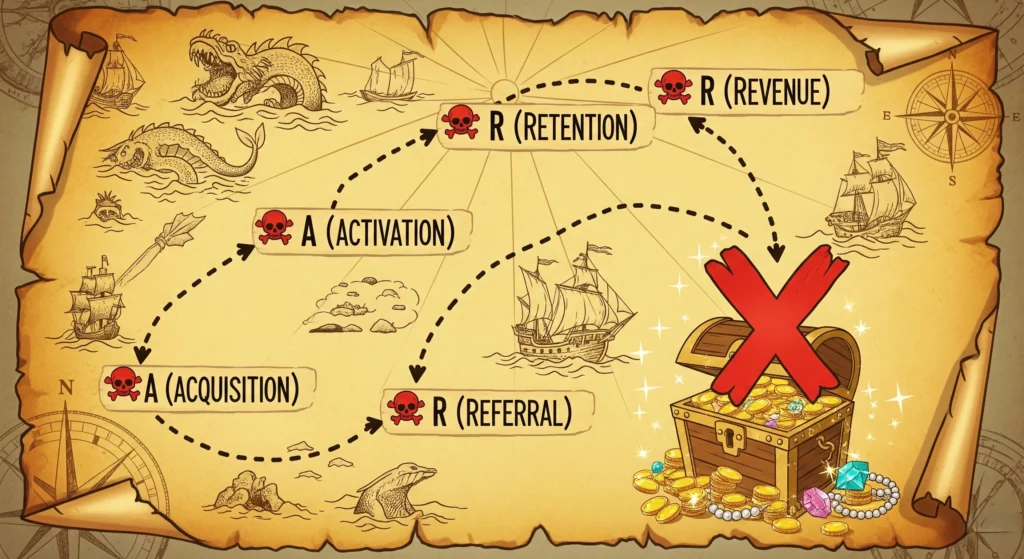
Over a decade ago, investor and founder Dave McClure got fed up with this complexity and introduced a simple, powerful framework designed to cut through the noise and focus on what really matters. He called it AARRR, or “Pirate Metrics,” because of the acronym’s sound. This isn’t just a clever name; it’s a battle-tested strategic framework that provides a clear, five-step lifecycle for understanding and optimizing your customer journey.
What is the AARRR Framework and what does each letter stand for?
The AARRR framework is a five-metric model for tracking the entire customer lifecycle, from their first contact with your brand to the point where they are generating revenue and referring others. It forces you to look at your business as a holistic system, not just a series of disconnected marketing campaigns.
The five stages are:
- Acquisition: How do users find you?
- Activation: Do users have a great first experience?
- Retention: Do users come back?
- Referral: Do users like it enough to tell others?
- Revenue: How do you make money?
By measuring your performance at each of these five distinct stages, you can diagnose exactly where your business is thriving and where it’s leaking, allowing you to focus your resources with surgical precision.
How do you apply and measure each stage of the AARRR funnel?
Let’s break down each stage with actionable examples and key metrics. This is how you put the framework into practice.
1. Acquisition (Getting Them in the Door)
- The Question: Which channels are driving traffic to your website or app?
- How to Optimize: This is your top-of-funnel marketing. You should be tracking the performance of each channel—SEO, paid ads, social media, content marketing, etc. The goal isn’t just to get traffic, but to get qualified traffic.
- Key Metrics: Website Visits per Channel, Cost per Acquisition (CAC), Click-Through Rate (CTR).
2. Activation (The “Aha!” Moment)
- The Question: Are new users experiencing the core value of your product for the first time?
- How to Optimize: This is all about the first-run experience. A user has signed up for your free trial or downloaded your app—now what? Activation is not just a sign-up; it’s the completion of a key action that demonstrates engagement. For Dropbox, it was uploading their first file. For Facebook, it was connecting with 7 friends in 10 days. Your goal is to get the user to this “aha!” moment as quickly and frictionlessly as possible through a great onboarding process.
- Key Metrics: Trial Sign-ups, % of Users Who Complete a Key Action, Time-to-Value.
3. Retention (Keeping Them Around)
- The Question: Are users coming back to use your product regularly?
- How to Optimize: This is arguably the most important stage. A business with high churn is a leaky bucket. Retention is driven by a great product, proactive customer support, and ongoing engagement through email newsletters, new feature announcements, and community building.
- Key Metrics: Churn Rate, Customer Lifetime Value (LTV), Daily/Monthly Active Users (DAU/MAU).
4. Referral (Creating Advocates)
- The Question: Are your users so happy that they are willing to become your marketing channel?
- How to Optimize: This is about turning customers into advocates. You can encourage this behavior through in-app referral programs (“Give $20, Get $20”), prompting for reviews after a positive experience, and creating shareable content. A strong referral loop is the hallmark of a product with true product-market fit.
- Key Metrics: Net Promoter Score (NPS), Viral Coefficient (how many new users each existing user generates), Number of Shares.
5. Revenue (Getting Paid)
- The Question: Are you successfully monetizing your users?
- How to Optimize: This stage is about the effectiveness of your business model. Are your pricing tiers clear? Is your upgrade path compelling? Are you converting free trial users to paid customers? This is where you test different pricing strategies, optimize your checkout flow, and identify opportunities for upselling and cross-selling.
- Key Metrics: Conversion Rate (to paid), Average Revenue Per User (ARPU), Monthly Recurring Revenue (MRR).
Why is AARRR so effective for modern businesses?
The AARRR framework is powerful because it forces you to think about the entire customer lifecycle as a single, interconnected system. It prevents you from falling into the trap of focusing on a single vanity metric (like acquisition) at the expense of the others (like retention).
By building a dashboard that tracks your key metric for each of the five stages, you get a real-time health report for your entire business. If acquisition is high but activation is low, you have an onboarding problem. If retention is low, you have a product or support problem. This framework doesn’t just give you data; it gives you a clear diagnosis and tells you exactly where to focus your efforts to make the biggest impact on your growth.
Stop Chasing Vanity Metrics and Start Building a Business
Are you measuring what matters? The AARRR framework provides a clear, no-BS roadmap to sustainable growth. At Buzz Hypnotica, we help businesses implement data-driven frameworks that cut through the noise and focus on the metrics that actually drive revenue. Let’s build your growth engine.
