
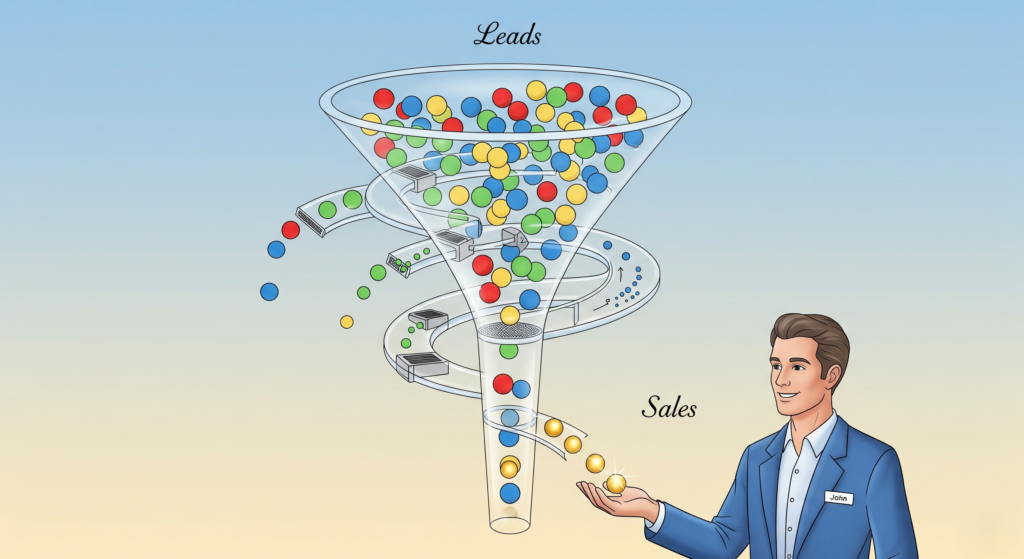
One of the biggest sources of friction between marketing and sales is lead quality. Marketing celebrates hitting its MQL (Marketing Qualified Lead) target, while sales complains about wasting time on prospects who will never buy. The solution isn’t more leads; it’s smarter leads. And that comes from a well-built lead scoring model.
A lead scoring model is a system that assigns points to leads based on their attributes and behaviours, helping you prioritize the ones most likely to convert. It turns your funnel from a firehose into a precision targeting system. The problem is, most companies get it wrong. They build overly complex models based on guesswork.
Here’s how to build one that your sales team will actually thank you for.
Step 1: Talk to Your Sales Team (Seriously)
Before you touch a single setting in your marketing automation platform, sit down with your top-performing salespeople. Ask them:
- “Describe our perfect customer. What industry are they in? What’s their job title? Company size?” (This will define your Explicit scoring criteria).
- “What actions does a prospect take right before they’re ready for a serious conversation? Do they visit the pricing page? Download a specific case study? Request a demo?” (This will define your Implicit or behavioural scoring criteria).
Your best customers are the blueprint. Use their attributes and journeys to build your model.
Step 2: Define Your Scoring Criteria (Explicit vs. Implicit)
Now, translate those conversations into a point system. Keep it simple to start.
- Explicit (Fit): Based on who they are. This data often comes from your forms.
- Job Title: C-Level/VP (+15), Director (+10), Manager (+5)
- Industry: Target Industry (+10), Non-Target (0)
- Company Size: Ideal Range (+10), Too Small (-20)
- Implicit (Interest): Based on what they do. This data comes from website tracking and email engagement.
- High-Intent Pages: Visited Pricing Page (+15), Requested Demo (+25)
- Mid-Funnel Engagement: Watched a Webinar (+10), Downloaded a Case Study (+10)
- Top-Funnel Activity: Subscribed to Blog (+2)
- Negative Scoring: Unsubscribed from Email (-10), Visited Careers Page (-20)
Step 3: Set the Threshold and Iterate
Decide on a point threshold that automatically qualifies a lead as an MQL and passes them to sales. For example, any lead with a score of 50 or more.
But don’t set it and forget it. Schedule a monthly check-in with the sales team. Review the leads that marketing passed over. Did they convert? If so, why? Were they scored too low? Conversely, which MQLs went nowhere? Were they scored too high? Use this real-world feedback to constantly refine your point values.
A lead scoring model isn’t a marketing project; it’s a sales enablement tool. When built collaboratively and refined with real data, it aligns both teams, shortens the sales cycle, and ensures your best leads get the attention they deserve.
Are your MQLs hitting a wall with the sales team? We specialize in bridging the gap between marketing and sales with data-driven systems like lead scoring. Let’s build a model that fuels your revenue engine.
