
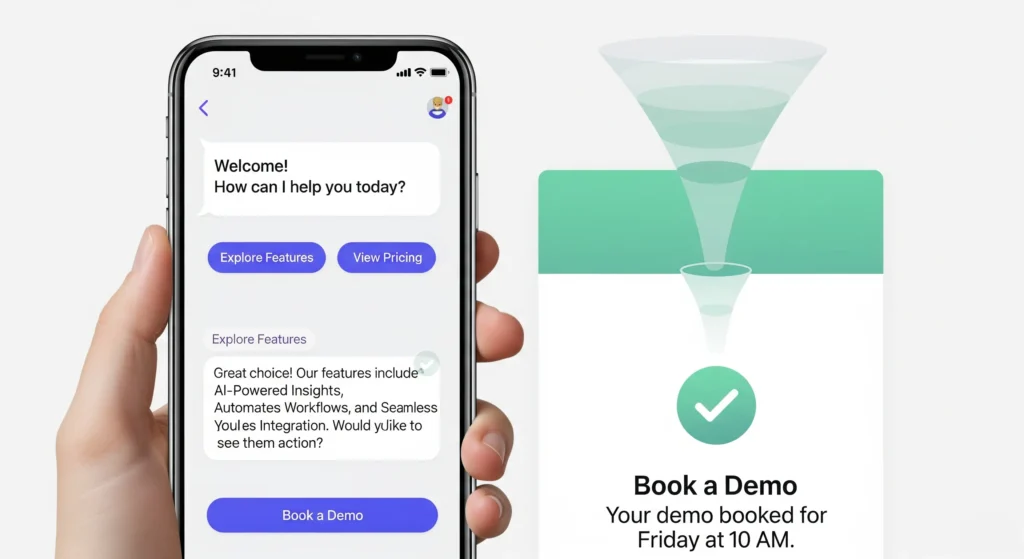
The traditional lead form is dying. It’s a cold, impersonal barrier that asks for a visitor’s most valuable asset—their contact information—in exchange for a vague promise of a future callback. In an age of instant gratification, making a potential customer wait is a death sentence for your conversion rates. They’ll just click back to Google and find a competitor who can help them now.
The solution isn’t a prettier form; it’s a better conversation. This is where chatbots and conversational funnels come in. When implemented correctly, a chatbot isn’t just a gimmick or an annoying pop-up; it’s your hardest-working employee. It’s a 24/7 sales development rep that can qualify leads, answer questions, and book meetings, all while your human team is asleep.
What exactly is a conversational funnel?
A conversational funnel is a framework that uses automated chat to guide a user through the customer journey in a real-time, interactive way. Instead of forcing a user to navigate a complex website to find what they need, the chatbot asks qualifying questions and serves up the right information or next step based on their answers. It turns a passive browsing experience into an active, guided conversation.
Think about the difference. A traditional funnel relies on the user to do all the work—find the pricing page, locate the case study, and finally fill out a form. A conversational funnel inverts this. It proactively asks, “Hey, I see you’re on our pricing page. Are you interested in our enterprise or small business plan?” Based on the answer, it can immediately provide the right information, a relevant case study, or a link to book a demo with the appropriate sales rep. It’s a personalized, frictionless experience.
How can chatbots do more than just answer basic questions?
The perception of chatbots is often stuck in the past—clunky, robotic scripts that can’t handle anything beyond a simple “What are your hours?” But modern AI-powered chatbots are incredibly sophisticated.
- Lead Qualification and Routing: This is the chatbot’s most powerful use case. You can program a bot with the same questions your best sales reps use to qualify a lead (company size, role, budget, timeline). Based on the user’s answers, the bot can score the lead in real-time. If they’re a high-value prospect, the bot can instantly connect them to a live sales rep or drop a link to their calendar to book a meeting. If they’re not a good fit, the bot can politely guide them to a helpful resource, saving your sales team countless hours.
- Proactive Engagement: A smart chatbot doesn’t wait to be asked. You can set triggers for a chatbot to proactively engage a user based on their behavior. For example, if a user has been idle on the checkout page for more than 30 seconds, a bot can pop up and ask, “Having trouble? Can I help you with a shipping question?” This can be the difference between a sale and an abandoned cart.
- 24/7 Customer Support: A chatbot can handle the vast majority of repetitive, first-tier customer support questions instantly. This frees up your human support agents to focus on the complex, high-touch issues that require a human touch. This not only improves customer satisfaction but also makes your support team more efficient.
What are the best practices for building a conversational funnel that doesn’t annoy users?
A bad chatbot experience can be worse than no chatbot at all. To make sure your conversational funnel is helpful, not intrusive, you need to follow a few key principles.
- Give It a Personality, But Keep It Professional: Your chatbot is an extension of your brand. Give it a name and a consistent tone of voice. However, don’t try to make it too human. A study by Nielsen Norman Group found that users are often frustrated when a bot tries too hard to mimic human conversation. Be clear that it’s a bot, and keep the interaction focused and efficient.
- Use Buttons and Quick Replies: Don’t force users to type out long answers. Whenever possible, provide buttons or pre-written replies they can tap. This makes the conversation faster, easier (especially on mobile), and reduces the chance of errors.
- Always Provide an “Escape Hatch”: There must always be a clear and easy way for a user to request to speak with a human. If a user gets stuck in a loop or has a complex question, trapping them with a bot will only lead to frustration. A simple “Talk to a person” button is non-negotiable.
- Start with a Specific Job: Don’t try to build a bot that can do everything at once. Start with one specific, high-value job. A great place to begin is a “Book a Demo” bot on your pricing page. Perfect that single use case, measure its performance, and then expand from there.
The future of the marketing funnel is interactive, immediate, and personal. By embracing conversational marketing, you’re not just optimizing a channel; you’re meeting your customers where they are and giving them the instant value they’ve come to expect.
Start the Conversation and Drive Conversions
Is your static website struggling to engage modern buyers? It’s time to make your funnel interactive. At Buzz Hypnotica, we help businesses design and implement high-converting conversational funnels that qualify leads, support customers, and drive revenue 24/7. Let’s build your hardest-working employee.
