
Picture this: you see an ad on Instagram for a sleek, black leather jacket with a 25% discount. You click it. But the link takes you to a generic homepage filled with dozens of different coats in all colors and styles. The black jacket is nowhere in sight, and there’s no mention of the discount. What do you do? You leave. Instantly.
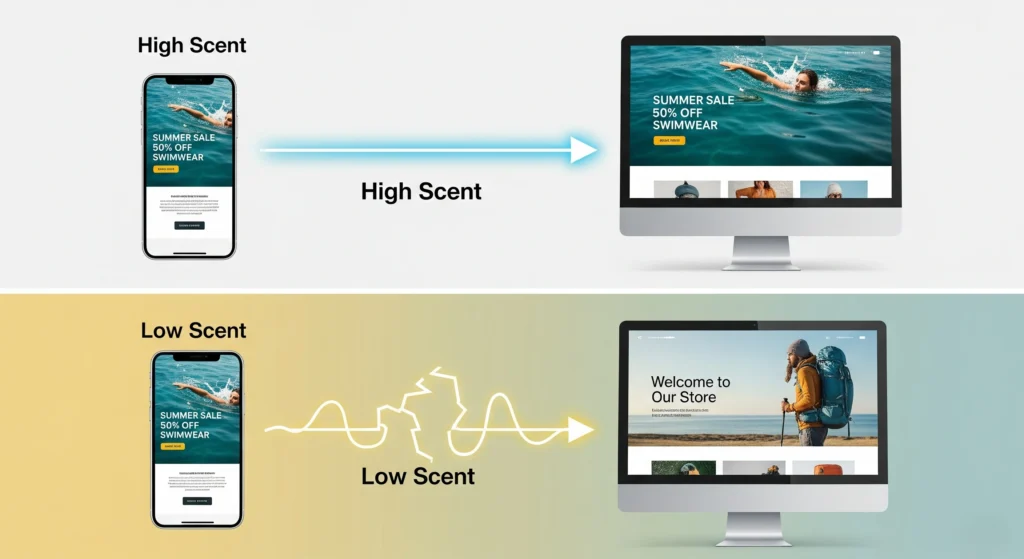
This jarring experience is a failure of one of the most critical, yet frequently overlooked, principles in digital marketing: Ad Scent, also known as Message Matching. It’s the simple idea that the user’s journey from ad to landing page should be a seamless, consistent, and intuitive path. When the “scent” is strong, the user feels confident they’re in the right place. When it’s broken, you create confusion, destroy trust, and incinerate your ad spend.
What exactly is Ad Scent and why does it have such a massive impact on conversions?
Ad Scent is the degree of visual and message consistency between an advertisement and the landing page it links to. A strong ad scent means the headline, keywords, imagery, branding, and offer presented in the ad are immediately and clearly reflected on the landing page. It confirms to the user, within seconds of arriving, that they have made a “good click.”
The impact is massive because it directly addresses the user’s cognitive biases and decision-making process. According to conversion experts at CXL, maintaining a consistent information trail is fundamental to a good user experience. When a user clicks an ad, they have a specific expectation and a goal in mind. If the landing page doesn’t immediately match that expectation, it triggers cognitive dissonance. The user has to stop and re-evaluate: “Am I in the right place? Was that ad misleading?” This moment of hesitation is all it takes to lose them. A strong ad scent eliminates that friction, creating a feeling of effortless navigation and validating their decision to click.
What are the core elements of strong Ad Scent?
To create a seamless experience, you need to ensure consistency across several key elements. A mismatch in any one of these can break the trail.
- The Headline: This is the most important element. The headline of your landing page should be a direct match or a very close variant of the headline in your ad. If your ad promises “The Easiest Way to Manage Your Invoices,” your landing page headline should not be “Welcome to FinCorp’s Accounting Solutions.”
- The Offer: If you promise a “50% Off Your First Month” discount in the ad, that exact offer must be front and center on the landing page. Don’t hide it in a banner or make them hunt for a promo code. It should be the first thing they see.
- Visual Consistency: The imagery, color scheme, and even the fonts used in your ad should be mirrored on the landing page. If you use a picture of a specific person or product in the ad, use that exact same image on the page. This creates an instant visual confirmation that they’ve landed in the right spot.
- Keyword and Message Congruence: The specific keywords and value propositions you use in your ad copy should be repeated on the landing page. This reassures the user that they are about to get the solution they were promised, reinforcing the core message of your campaign.
How can I diagnose and fix broken Ad Scent in my own campaigns?
Fixing broken ad scent is one of the highest-ROI activities a marketing team can undertake. Here’s a simple, actionable process.
- Step 1: The Ad-to-Page Audit: Create a simple spreadsheet. In one column, list your top-performing ads (by clicks). In the next column, put the destination URL. Now, go through them one by one. Click each ad and perform a “5-second test” on the landing page. Ask yourself: Can I immediately confirm the promise of the ad? Is the headline the same? Is the offer visible? Is the imagery consistent? Grade each journey on a simple A-F scale. You’ll be shocked at what you find.
- Step 2: Build Dedicated Landing Pages: The number one cause of broken ad scent is sending paid traffic to a generic homepage. Don’t do it. Ever. Every significant ad campaign or ad group deserves its own dedicated landing page that is specifically designed to match the ad creative and message. Tools like Unbounce or Instapage make this incredibly easy to do without needing a developer.
- Step 3: Leverage Dynamic Text Replacement (DTR): For search campaigns with many different keywords, DTR is a powerful tool. It allows you to automatically insert the keyword a user searched for directly into the headline and copy of your landing page. This creates a hyper-relevant, perfectly matched experience for every single user, no matter which keyword they used.
- Step 4: A/B Test Your Scent: Once you have a consistent journey, start testing. Can you improve the scent even further? Test different headline variations that still match the ad. Test different hero images. The goal is a continuous process of refining that ad-to-page experience to be as frictionless as possible.
In a world where you pay for every click, you cannot afford to waste that investment on a confusing user experience. Mastering Ad Scent is the difference between a PPC campaign that breaks even and one that becomes a scalable, profitable growth engine for your business.
Turn Clicks into Conversions
Is your ad spend leaking away due to a broken user journey? Don’t let a mismatched message kill your ROI. At Buzz Hypnotica, we specialize in building high-converting funnels, starting with a seamless ad-to-page experience. Let’s fix your Ad Scent and turn more of your clicks into valuable customers.
