
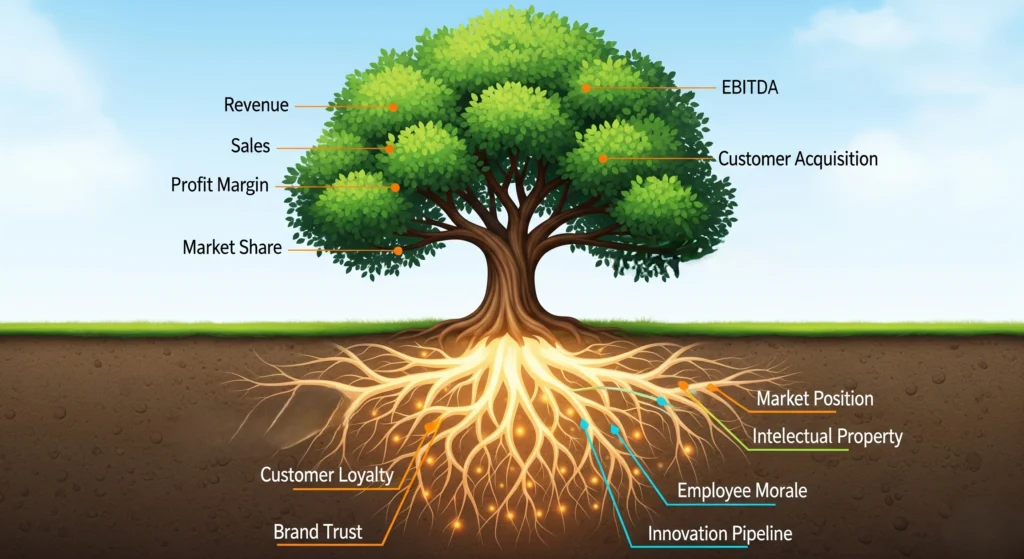
In the boardroom, there are two languages: the language of marketing and the language of finance. Marketers talk about engagement, reach, and share of voice. Finance talks about EBITDA, cash flow, and enterprise value. Too often, these conversations happen in different rooms, leading to the age-old perception of marketing as a “cost center.” But what if you could bridge that gap? What if you could draw a straight, undeniable line from your marketing budget to the single most important number on the CFO’s mind: the total value of the company?
This isn’t a theoretical exercise. It’s the most critical strategic conversation a CMO can have. Understanding how to translate marketing activities into Enterprise Value is the difference between being a tactical function and being a core driver of the business. It’s how you justify long-term brand building in a world obsessed with short-term ROI.
What is Enterprise Value and why should marketers care?
Enterprise Value (EV) is a measure of a company’s total value, often used as a more comprehensive alternative to market capitalization. It’s calculated as Market Capitalization + Total Debt – Cash and Cash Equivalents. In simpler terms, it’s what it would cost to buy the entire company. Marketers should care because a huge portion of that value is derived from intangible assets, and marketing is the department responsible for creating and growing most of them.
These intangible assets—brand reputation, customer loyalty, market position, intellectual property—don’t always show up on a traditional balance sheet, but they are precisely what acquirers and investors are paying for. A strong brand allows you to charge premium prices, reduces customer churn, and attracts better talent. As brand valuation experts at Brand Finance regularly report, the world’s most valuable brands consistently outperform the broader stock market. Your work directly builds this value.
How do you translate brand-building activities into financial terms?
This is the crux of the challenge. How do you quantify something as “soft” as brand loyalty? You do it by focusing on the measurable financial outcomes that these intangibles produce.
- Brand Equity as a Price Premium: A strong brand can command a higher price than a generic competitor. You can measure this by analyzing your pricing power relative to the market. Can you raise prices without losing significant market share? That price elasticity is a direct financial result of your brand equity.
- Customer Loyalty as Reduced Churn: As we’ve discussed, reducing churn has a massive impact on financial performance. By tracking your customer retention rate and Customer Lifetime Value (LTV), you can assign a hard dollar value to the loyalty your brand inspires. A lower churn rate than your competitors is a tangible financial asset.
- Market Position as a Barrier to Entry: A dominant market position, built through consistent thought leadership and category creation, creates a moat around your business. You can measure this by tracking your “share of voice” in the market and analyzing how much more expensive it is for a new competitor to acquire customers compared to you (your relative CAC).
What is the framework for presenting marketing’s contribution to Enterprise Value?
When speaking to your board or the C-suite, you need to present a clear, logical narrative that connects your activities to their financial outcomes.
- Start with the Foundation: Customer Economics: Begin with the hard numbers. Present your LTV:CAC ratio and CAC Payback Period. This establishes that you have a profitable, scalable customer acquisition model. This is the bedrock of your argument.
- Layer on the Intangibles (The Brand Multiplier): Once you’ve established the foundation, introduce the brand metrics. Show how your brand’s strength (measured by things like Net Promoter Score or brand recall surveys) allows you to achieve those strong unit economics. Frame it as a multiplier. For example: “Our strong brand trust allows us to maintain a 15% price premium over competitors, which directly increases our LTV and shortens our payback period.”
- Connect to Future Growth (The Strategic Narrative): Finally, connect these assets to the company’s long-term strategy. How does your brand’s reputation in the market de-risk the launch of a new product? How does your strong customer loyalty provide a stable base for future revenue projections? You need to show that you’re not just reporting on past performance, but building the assets that will guarantee future cash flows.
The conversation shifts from “How many leads did we get last month?” to “How are our marketing investments building a more valuable, defensible business for the long term?” It’s a harder conversation to have, but it’s the one that earns you a real seat at the table.
From Cost Center to Value Creator
Are you struggling to prove the long-term value of your marketing efforts? It’s time to start speaking the language of the boardroom. At Buzz Hypnotica, we help marketers build the frameworks to connect their work directly to enterprise value. Let’s build your case and secure your seat at the table.
