
In business, we are wired for optimism. We kick off big projects with fanfare, focusing on all the ways we’re going to succeed. We build best-case-scenario timelines and celebrate the launch before a single line of code is written. But what if the smartest way to ensure success was to start by assuming complete and utter failure?
This is the brilliantly counterintuitive logic behind the Premortem, a powerful strategic tool for de-risking projects. A postmortem happens after a project has already died, where you dissect what went wrong. A premortem, by contrast, happens right at the beginning, before the project has even started. It’s a proactive, imaginative exercise in failure that can save you from experiencing the real thing.
What exactly is a Premortem and how does it work?
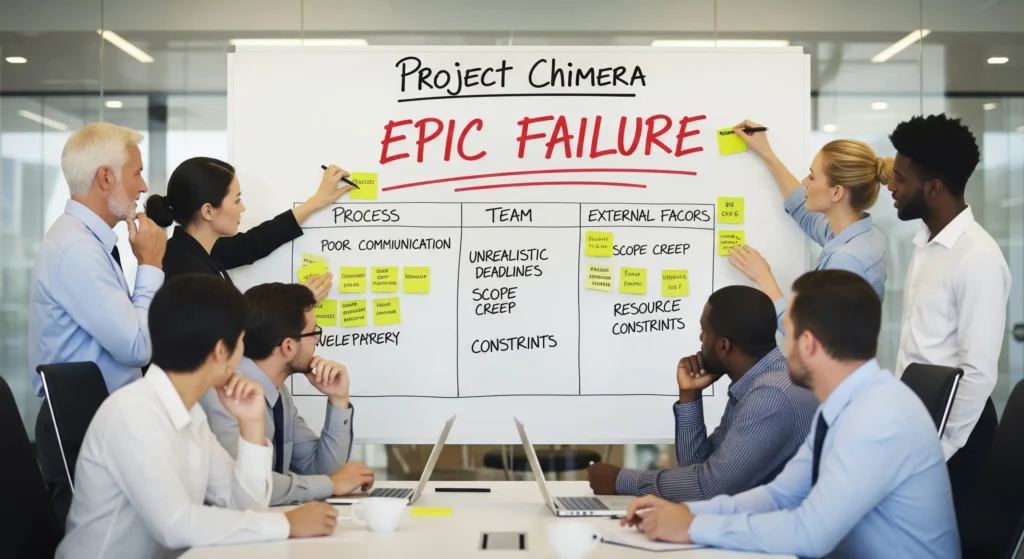
A Premortem is a facilitated meeting where a project team is asked to imagine that the project they are about to start has already happened and has been a catastrophic failure. Their task is to generate all the plausible reasons why it failed. It’s a form of prospective hindsight.
The process, developed by psychologist Gary Klein, is designed to counteract the dangerous effects of groupthink and overconfidence that plague the early stages of a project. By framing the failure as a certainty, it liberates team members to voice concerns and doubts that they might otherwise keep to themselves for fear of seeming negative or not being a team player.
The typical process looks like this:
- The Setup: At the project kickoff, the facilitator says, “The crystal ball is telling us that six months from now, this project has failed completely. It’s been a disaster.”
- Individual Brainstorming: Each team member takes 5-10 minutes to silently write down every possible reason for the failure.
- Round-Robin Sharing: The facilitator goes around the room, asking each person to share one reason from their list. This continues until all unique reasons have been shared and are listed on a whiteboard.
- Discussion and Prioritization: The team then discusses the list, consolidates similar items, and prioritizes the most significant and likely risks.
- Action Planning: Finally, the team turns this list of potential failures into an action plan. For each major risk, they brainstorm ways to mitigate or prevent it from happening.
Why is this exercise so much more effective than a typical risk assessment?
A standard risk assessment asks, “What might go wrong?” A premortem asks, “What did go wrong?” This subtle shift in framing is a psychological masterstroke.
- It Overcomes Optimism Bias: As Daniel Kahneman, the Nobel Prize-winning psychologist, has noted, humans are naturally prone to overconfidence. The premortem shatters this by making failure the starting point, not a distant possibility.
- It Legitimizes Dissent: It creates a safe, structured space for constructive criticism. The person who points out a major flaw is no longer a pessimist; they are a valuable contributor to the exercise. It encourages a diversity of thought and uncovers risks that the project leader may have been blind to.
- It Taps into a Different Kind of Creativity: Imagining success is easy. Imagining specific, detailed paths to failure requires a more critical and creative kind of thinking. It forces the team to consider second- and third-order consequences that are often missed in traditional planning.
What kind of problems can a Premortem uncover?
A well-run premortem can uncover a huge range of potential issues that would have otherwise emerged as “unforeseen” problems halfway through the project.
- Flawed Assumptions: “We failed because we assumed our target audience uses Instagram, but we discovered too late that they’re all on a niche Discord server.”
- Resource Mismatches: “We failed because the engineering team was pulled onto another ‘higher priority’ project a month after we started.”
- External Threats: “We failed because a new competitor launched a similar feature two weeks before us, and our messaging looked like a copycat.”
- Internal Misalignment: “We failed because the sales and marketing teams had completely different ideas about who the ideal customer was, and our launch campaign was a mess.”
By identifying these potential disasters upfront, the team can strengthen the project plan. They might decide to do more audience research, secure dedicated resources, build a contingency plan for a competitive launch, or force a critical alignment meeting between sales and marketing. The premortem turns a list of anxieties into a concrete, actionable risk mitigation plan. It’s the ultimate tool for turning pessimism into a strategic advantage.
Plan for Success by Imagining Failure
Are your biggest projects launching with more hope than strategy? It’s time to de-risk your investments and increase your chances of success. At Buzz Hypnotica, we facilitate strategic planning sessions that use powerful frameworks like the Premortem to build resilient, successful project plans. Let’s make your next launch your most successful one yet.
